Flat Roofing London
Most Flat Roof Leaks Aren't a Membrane Problem
The most common mistake we see on flat roofs isn't a failed material — it's a roof that was never built with enough fall in the first place.
"Fall" is the slight built-in slope that lets water actually run off a flat roof instead of sitting on it, and it's created by firrings — tapered timber battens laid underneath the covering.
Get the fall wrong, and water pools in the same low spot after every rainfall, slowly working its way through the membrane over months or years, however good the material on top actually is.
Re-covering a roof with the same fall problem just delays the same failure. Before we recommend any material, we check whether the roof is actually draining properly — because a brand-new membrane laid over bad falls will fail again, just more slowly than the last one did.
Backed By a Guarantee That Matches the Material
Every EPDM or GRP flat roof we install carries a 10-year guarantee. Felt roofing, which has a shorter working life by nature of the material, carries a 5-year guarantee — proportionate to what the material itself can realistically deliver, not an arbitrary number.
We're verified members of TrustATrader, rated 4.9/5 from real customer reviews, and every flat roof job is carried out by our own uniformed, insured team — never subcontracted out.


What Customers Say About Us
Real reviews. Real workmanship. Real results.




Get A Quote
EPDM, GRP, or Felt — Which One Actually Suits Your Roof
EPDM Rubber A single rubber membrane with no seams or joins, meaning fewer points where water can eventually find a way in. Typically the longest-lasting option, commonly 25-30+ years when installed correctly.
GRP Fibreglass A cold-applied liquid resin that cures into one seamless, rigid sheet, well suited to balconies and roofs with foot traffic. Typically guaranteed around 20 years, with a hard-wearing, walkable finish.
Felt Modern multi-layer torch-on felt, the most affordable option upfront, with the shortest lifespan of the three systems here — typically 10-15 years, but a genuinely sensible choice for garages, sheds, and lower-budget projects.
We'll recommend based on your roof's size, use, and budget — not whichever system happens to be easiest for us to install that week.
How We Approach a Flat Roof
Warm Roof or Cold Roof — The Distinction Most Quotes Skip
A flat roof isn't just the visible covering — what's underneath it matters just as much for how long it lasts and how well your property stays insulated.
A cold roof has insulation fitted between the joists, below the deck. It's the traditional, cheaper build method, but it leaves the deck itself exposed to cold air from below, which can cause condensation to form on the underside over time.
A warm roof has rigid insulation fitted above the deck, underneath the waterproof membrane. This keeps the whole structure at a consistent temperature, virtually eliminates condensation risk, and meets current UK energy efficiency standards far more comfortably than a cold roof build.
Where it makes sense for your project, we'll talk you through upgrading to a warm roof build during a re-cover — it costs more upfront than a like-for-like cold roof replacement, but it solves a problem a lot of flat roofs have for their entire working life otherwise.
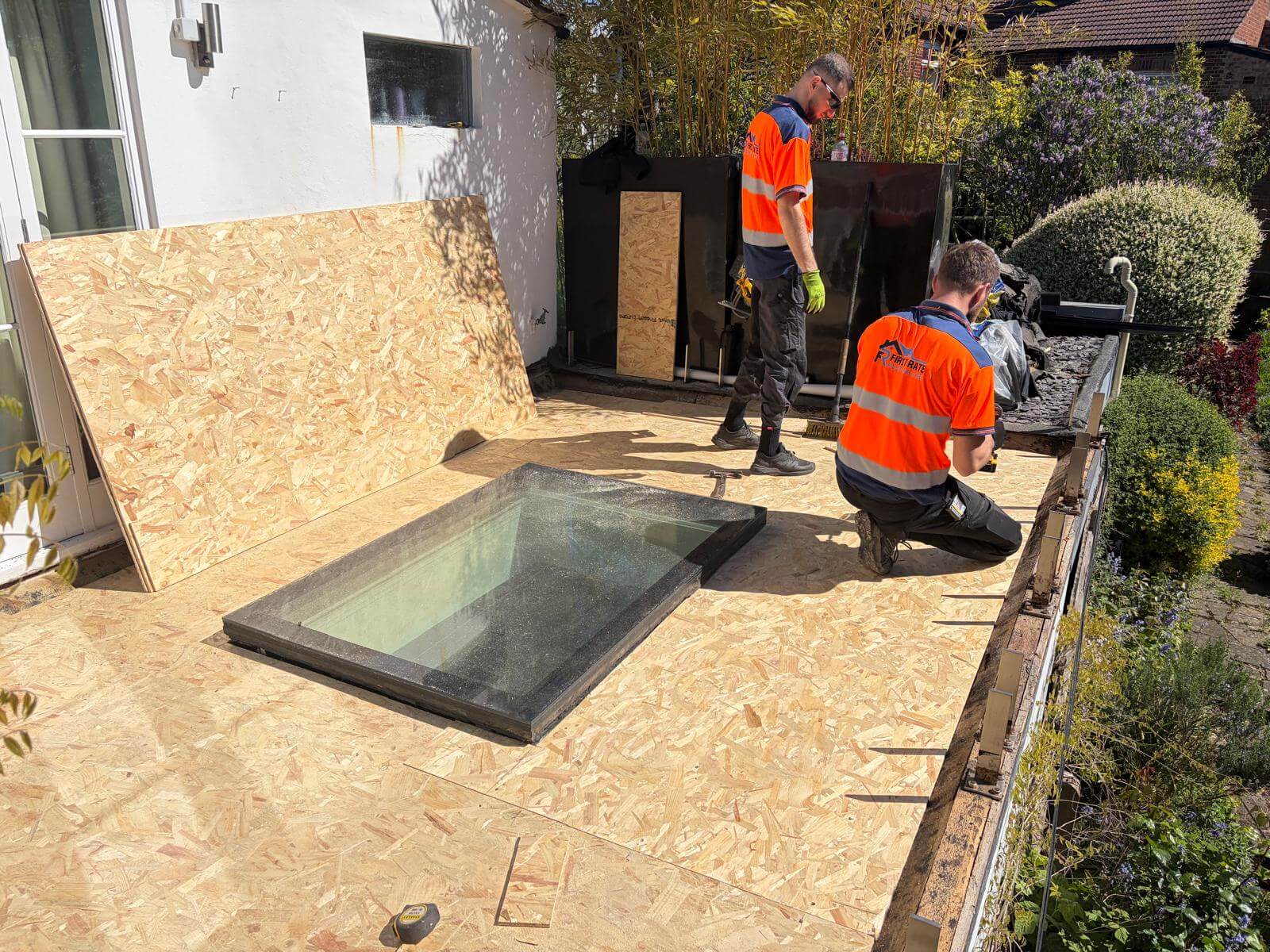
Building the Roof Around the Rooflight, Not Bolting One On After
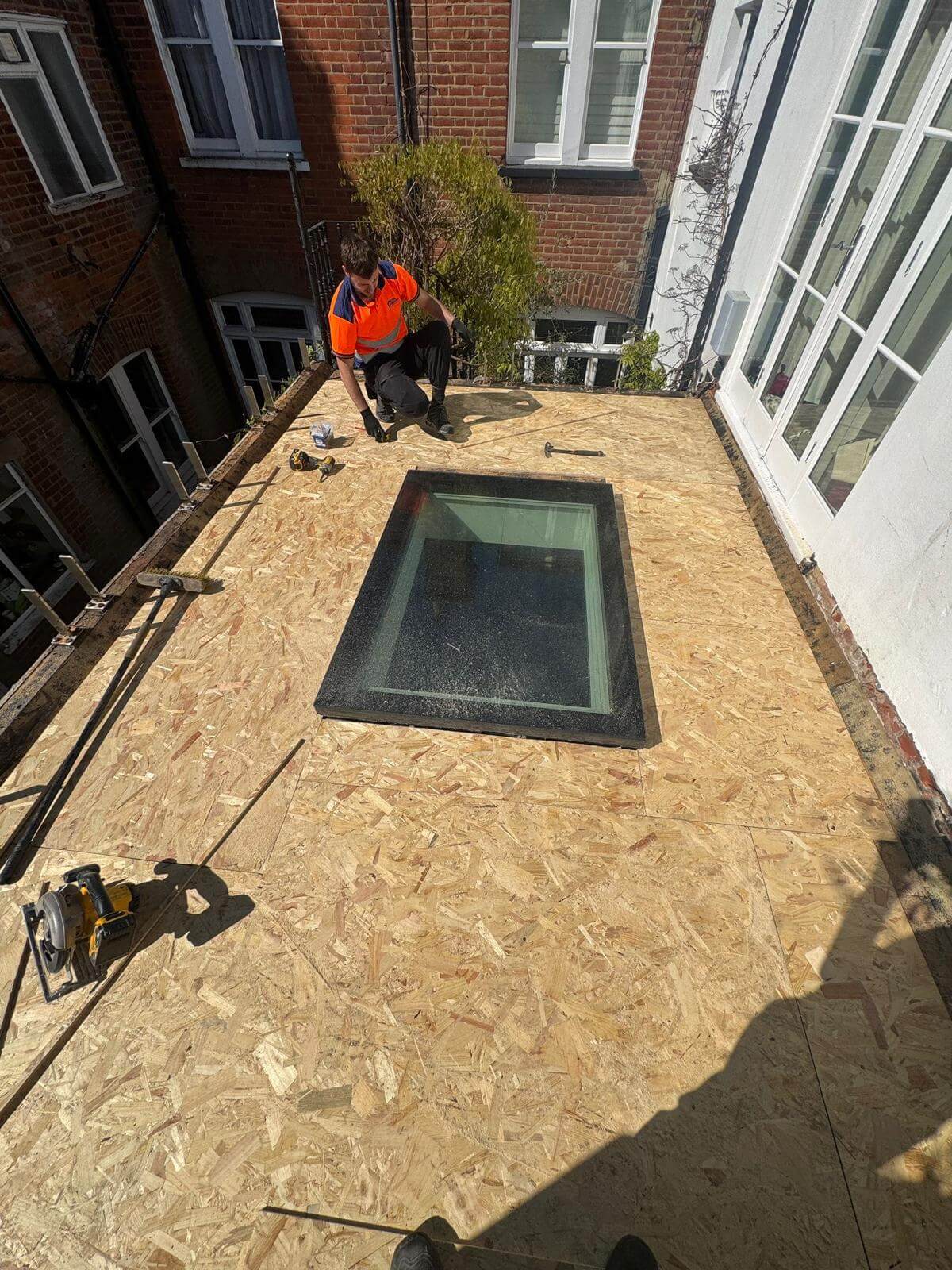
This is what a proper flat roof build looks like before the waterproof membrane goes on — OSB decking laid across the full roof structure, with the rooflight opening cut and framed in from the start, not squeezed in as an afterthought once the roof's already finished.
Getting this stage right matters more than it looks like it should. A rooflight fitted into a properly framed, level opening seals cleanly against the surrounding roof. One fitted into a rough or uneven cut is fighting a losing battle against water ingress from day one, no matter how good the flashing around it is. This is the groundwork stage — unglamorous, but it's exactly where a flat roof either gets built to last or doesn't.
Flat Roofing FAQ's
Why does my flat roof keep getting a puddle in the same spot? This is almost always a fall problem, not a material problem — the roof wasn't built with enough slope to drain properly in that area. Re-covering without fixing the fall means the same puddle comes back, whatever material goes on top.
Which flat roofing material lasts longest? EPDM rubber, typically 25-30+ years when installed correctly, followed by GRP fibreglass around 20 years, then felt at 10-15 years. Longer-lasting materials cost more upfront but often work out better value over the roof's life.
What's the difference between a warm roof and a cold roof? A warm roof has insulation above the deck, underneath the membrane, which largely eliminates condensation risk. A cold roof has insulation between the joists below the deck, which is cheaper but more prone to condensation forming on the underside over time.
Can you repair my flat roof instead of replacing it? Often, yes — if the damage is localised and the falls are otherwise sound, a repair can extend the roof's life at a fraction of the cost of a full re-cover. We'll give you a straight answer during the free inspection.
How long does a flat roof installation take? Most garage or extension-sized flat roofs are completed within 1-3 days, weather permitting — GRP specifically needs dry conditions and a suitable temperature to cure properly.
Do you handle balconies and roofs with foot traffic, not just standard flat roofs? Yes — GRP fibreglass in particular is well suited to balconies and other trafficked flat roof areas, given its hard-wearing, seamless finish.
Any Questions?
Ask Us
Signs Your Flat Roof Needs Attention
A patch of standing water more than 48 hours after rain — this is the fall problem described above, not just "normal" for a flat roof. Water shouldn't still be sitting there two days later.
Bubbling or blistering on the surface — usually trapped moisture underneath the membrane, often a sign the covering's reaching the end of its working life.
Cracking or splitting, especially at edges and upstands — the joins and edges are where a flat roof fails first, well before the flat surface itself.
A ceiling stain directly below the flat roof — flat roofs rarely leak in dramatic fashion; it's usually a slow, steady patch that gets worse after every heavy rain.
Visible sagging — can indicate structural timber issues underneath, not just a surface-level covering problem, and is worth a proper inspection rather than a quick re-cover.
Additional Roofing Services in London
A repair isn't always the only thing on a roof that needs attention — guttering, flashing, and chimneys often fail around the same time as the main covering, since they're all exposed to the same weather and age at a similar rate. Below are the other services our team carries out across London.


Get a Free Inspection On Your Flat Roof
We check the fall, not just the covering — because a new membrane over the same drainage problem is a repair that's already failing.
Call or WhatsApp 07455 632326 for same-day response across South London, South West London, and Surrey.