Search “new roof cost” and you’ll find national averages of £4,000–£8,000 for a terraced house. Then a London roofer quotes you £11,000 and you wonder what’s going on.
Two things are going on. First, London costs more: labour, parking, scaffolding licences and access all push prices up, and most cost guides put London 25–35% above the UK average. Second, a lot of online figures are for the cheapest possible version of the job, and a cheap re-roof and a proper re-roof are not the same product.
I’m John Quilligan. We’re not the cheapest roofer in South London and we don’t try to be. This guide sets out what a properly done re-roof costs here in 2026, what you should be getting for that money, and how to tell whether a lower quote is a genuine saving or a missing step.
The Quick Answer
| Re-roof (typical London terrace or semi) | Typical cost, including scaffolding |
|---|---|
| Concrete or clay tile | £7,000–£12,000 |
| Natural slate | £10,000–£16,000 |
| Full re-roof including new timbers and insulation upgrade | £13,000–£20,000 |
Detached houses, hipped roofs, dormers, several chimneys and three-storey Victorian terraces sit at the top of these ranges or above them.
Price per Square Metre
| Material | Typical cost per m², fitted | Expected lifespan |
|---|---|---|
| Concrete tile | £103–£150 | 50–60 years |
| Clay tile | £126–£200 | 60–100 years |
| Natural slate | £172–£275 | 75–100+ years |
A typical two- or three-bed London terrace has somewhere around 50–80m² of roof. Per-metre prices are useful for comparing quotes, but scaffolding, chimneys, leadwork and any timber repairs sit on top.
What a Proper Re-Roof Includes
This is where quotes really differ. Every one of these should be on a written quote for a full re-roof. If it isn’t there, ask.
- Scaffolding erected by a qualified scaffolding firm, with any pavement licence the council requires.
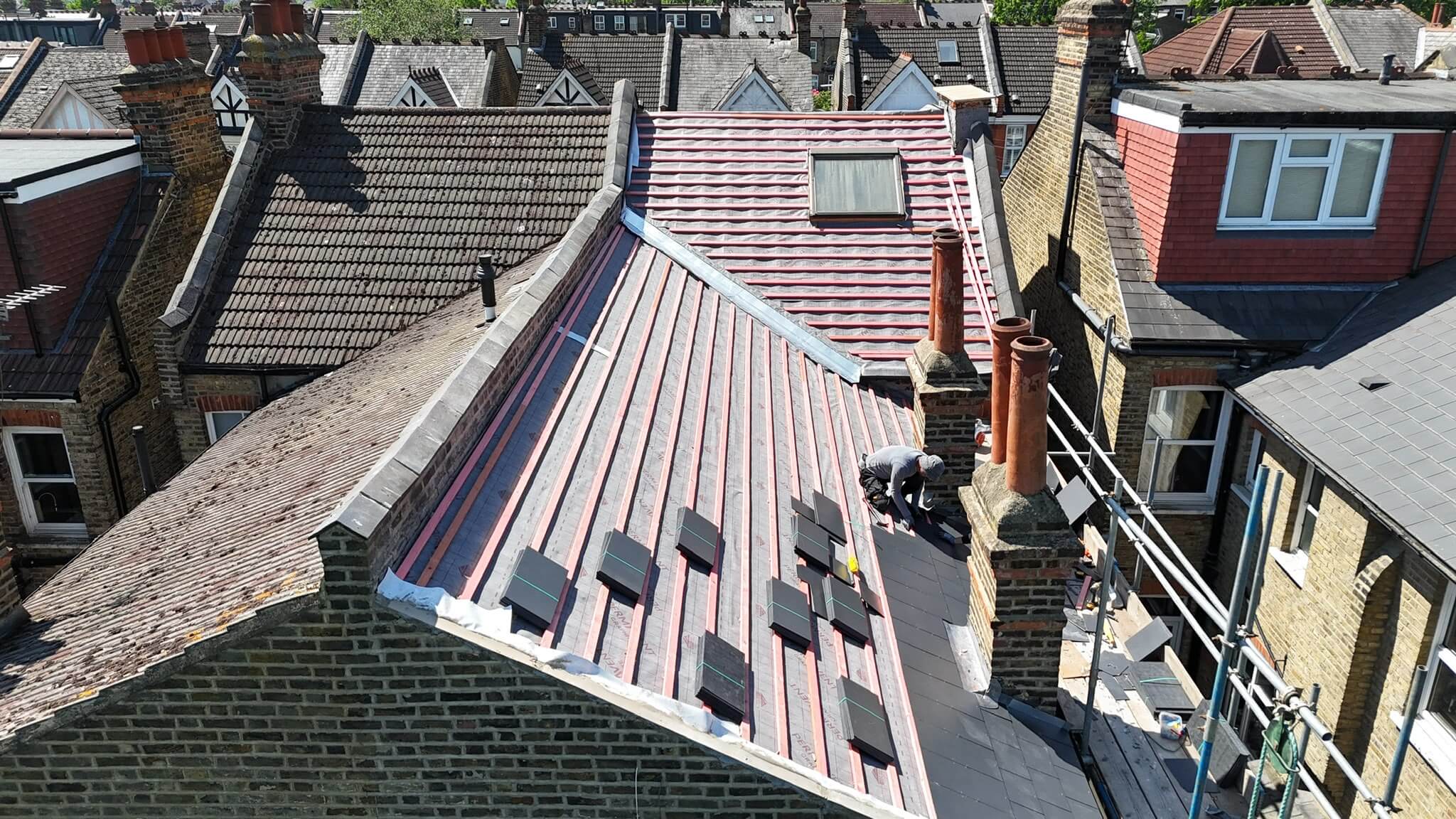
- Full strip of the old covering, underlay and battens, with the waste removed by a licensed carrier.
- A timber check of rafters, wall plates and fascia boards once the roof is open, with photos of anything that needs attention.
- New breathable membrane rather than old-style bitumen felt, so the loft can breathe and condensation doesn’t build up.
- New treated battens of the correct grade and size. A “re-roof” that reuses the old battens isn’t really a re-roof.
- Mechanical fixing to the current British Standard (BS 5534). Ridge, hip and verge tiles should be mechanically fixed, not just bedded on mortar, which is why most new roofs now use dry ridge and dry verge systems.
- New leadwork to chimneys, abutments and valleys where needed, in the correct code of lead, not the old lead dressed back down.
- Roof ventilation at the eaves and ridge so the timbers stay dry.
- Building Regulations sign-off. Re-roofing more than about a quarter of a roof is notifiable work, and you’ll need the completion certificate when you sell.
- A written guarantee. Ours is 25 years on a new roof, with insurance-backed cover through our CORC membership.
Why Quotes for the Same Roof Can Be Thousands Apart
It’s not unusual for London homeowners to get quotes for the same roof that are £5,000 or more apart. Sometimes the cheaper firm genuinely has lower costs. More often, something has been left out. The usual gaps are:
- Scaffolding excluded or priced for too short a hire, with extra weeks added later.
- Old battens reused, or new membrane laid over failing timbers without anyone checking.
- Ridges re-bedded on mortar only, which doesn’t meet the current standard and tends to crack and slip within a few years.
- Old lead reused, or flashings sealed with mastic instead of being properly dressed and fixed.
- No Building Regulations notification, which surfaces as a problem when you come to sell.
- Uninsured or under-insured labour, so if something goes wrong, there’s nobody to claim against.
- Timber repairs “to be confirmed” with no rate agreed, which leaves you exposed once the roof is stripped.
A higher quote isn’t automatically better. But a quote that’s thousands lower deserves the question: what aren’t you doing that the others are?
What Pushes the Price Up
- Roof shape. Hips, valleys and dormers take far longer to cut in than a simple gable.
- Height and access. Three-storey houses, roofs over conservatories and terraces with rear access only need more scaffolding.
- Chimneys. Each stack needs new flashing and often repointing or flaunching at the same time.
- Timber condition. Rot or undersized rafters found once the roof is stripped.
- Material choice and planning. Natural slate is dearer and slower to lay, and in a conservation area you may need to match the original material.
- Insulation. Upgrading the loft insulation to current standards is often required at the same time.
How Long Does It Take?
A typical London terrace or semi takes around one to two weeks on site once the scaffolding is up, depending on the weather, the material and what we find once the old roof is off. Slate takes longer than tile. We keep the roof weathertight every night.
Do You Actually Need a New Roof?
Often, no. Many roofs we’re asked to replace need a targeted repair instead. If you’re not sure, read our guide to the signs your roof needs replacing, or ask for a free inspection and we’ll give you an honest answer either way, with photos.
Frequently Asked Questions
Is VAT included in these prices? Always check. Our written quotes show the full price you’ll pay, so there are no surprises on the final invoice.
Do I need planning permission to replace my roof? Not for a like-for-like replacement on most houses. You may need it if you’re in a conservation area or a listed building, or if you’re changing the material or the shape of the roof.
Can I reuse my existing slates or tiles? Sometimes. Good natural slate can often be reused or topped up with reclaimed slate to match. Old concrete tiles usually aren’t worth saving.
How much deposit should I pay? Be wary of anyone who asks for most of the money up front. A staged payment schedule linked to progress is normal.
Get a Proper Quote
Free inspection, no call-out fee, and a fully itemised written quote, so you can see exactly what’s included and compare it fairly with anyone else’s. Every new roof comes with a 25-year guarantee. See our roof replacements page, or call or WhatsApp 07455 632326.